Welcome to qc2’s documentation!
About qc2
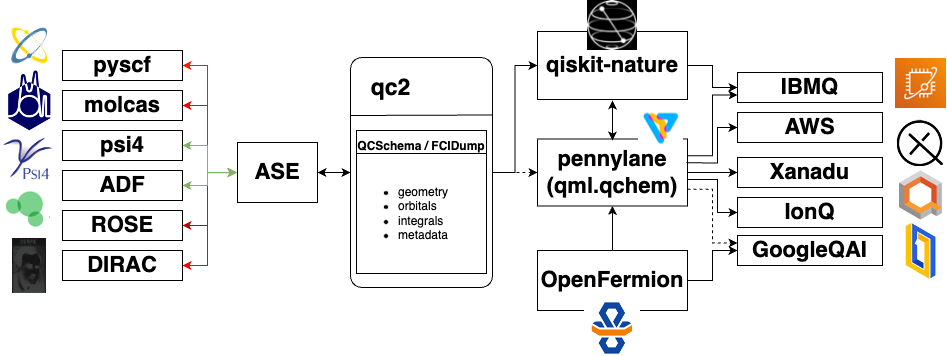
Code structure diagram
qc2 is a modular software designed to seamlessly integrate traditional computational chemistry codes and quantum computing frameworks. It is specifically crafted for hybrid quantum-classical workflows such as the variational quantum eigensolver (VQE) algorithm [CRO+19, TCC+22]. The software relies on custom ASE calculators as well as formatted data files (e.g., QCSchema or FCIDump [KH89]) to efficiently offload 1- and 2-electron integrals needed by various Python quantum computing libraries; see Code structure diagram.
The qc2 software is a direct outcome of the QCforQC project, a collaboration between Netherlands eScience Center, Vrije Universiteit Amsterdam (VU) and SURF.
Current status of qc2
In its current version, qc2 can run hybrid quantum-classical computations using both Qiskit Nature and PennyLane, along with the following computational chemistry programs:
For these programs, custom qc2-ASE calculators are developed that implement additional methods to retrieve and dump qchem data into formatted data files; see qc2-ASE calculators.
Note
qc2-ASE calculators for ADF and MOLCAS are currently under development and will be available soon.
Current implemented algorithms are:
For further details; see qc2/algorithms module and Algorithms section.
The QCforQC team
The QCforQC collaboration is currently composed by the following members:
Nicolas Renaud - Netherlands eScience Center
Carlos M. R. Rocha - Netherlands eScience Center
Luuk Visscher - Vrije Universiteit Amsterdam
Ariana Torres - SURF
Bibliography
Yudong Cao, Jonathan Romero, Jonathan P. Olson, Matthias Degroote, Peter D. Johnson, Mária Kieferová, Ian D. Kivlichan, Tim Menke, Borja Peropadre, Nicolas P. D. Sawaya, Sukin Sim, Libor Veis, and Alán Aspuru-Guzik. Quantum chemistry in the age of quantum computing. Chemical Reviews, 119:10856–10915, 2019. doi:10.1021/acs.chemrev.8b00803.
Peter J. Knowles and Nicholas C. Handy. A determinant based full configuration interaction program. Computer Physics Communications, 54:75–83, 1989. doi:https://doi.org/10.1016/0010-4655(89)90033-7.
Wataru Mizukami, Kosuke Mitarai, Yuya O. Nakagawa, Takahiro Yamamoto, Tennin Yan, and Yu-ya Ohnishi. Orbital optimized unitary coupled cluster theory for quantum computer. Physical Review Research, 2:033421, 2020. doi:10.1103/PhysRevResearch.2.033421.
Bruno Senjean, Souloke Sen, Michal Repisky, Gerald Knizia, and Lucas Visscher. Generalization of intrinsic orbitals to kramers-paired quaternion spinors, molecular fragments, and valence virtual spinors. Journal of Chemical Theory and Computation, 17:1337–1354, 2021. doi:10.1021/acs.jctc.0c00964.
Per E. M. Siegbahn, Jan Almlöf, Anders Heiberg, and Björn O. Roos. The complete active space SCF (CASSCF) method in a Newton–Raphson formulation with application to the HNO molecule. The Journal of Chemical Physics, 74:2384–2396, 1981. doi:10.1063/1.441359.
Igor O. Sokolov, Panagiotis Kl. Barkoutsos, Pauline J. Ollitrault, Donny Greenberg, Julia Rice, Marco Pistoia, and Ivano Tavernelli. Quantum orbital-optimized unitary coupled cluster methods in the strongly correlated regime: Can quantum algorithms outperform their classical equivalents? The Journal of Chemical Physics, 152:124107, 2020. doi:10.1063/1.5141835.
Jules Tilly, Hongxiang Chen, Shuxiang Cao, Dario Picozzi, Kanav Setia, Ying Li, Edward Grant, Leonard Wossnig, Ivan Rungger, George H. Booth, and Jonathan Tennyson. The variational quantum eigensolver: a review of methods and best practices. Physics Reports, 986:1–128, 2022. doi:https://doi.org/10.1016/j.physrep.2022.08.003.
Saad Yalouz, Bruno Senjean, Jakob Günther, Francesco Buda, Thomas E O’Brien, and Lucas Visscher. A state-averaged orbital-optimized hybrid quantum–classical algorithm for a democratic description of ground and excited states. Quantum Science and Technology, 6(2):024004, 2021. doi:10.1088/2058-9565/abd334.
Luning Zhao, Joshua Goings, Kyujin Shin, Woomin Kyoung, Johanna I. Fuks, June-Koo Kevin Rhee, Young Min Rhee, Kenneth Wright, Jason Nguyen, Jungsang Kim, and Sonika Johri. Orbital-optimized pair-correlated electron simulations on trapped-ion quantum computers. npj Quantum Inf, 9:60, 2023. doi:10.1038/s41534-023-00730-8.
Indices and tables
Footnotes